
How timbre, texture, uncertainty and the dialogue between picture and sound create mystery: techniques for film composers. We explore the tools, production choices and practical implications behind this announcement, with a focus on what matters in a real studio.
This feature explores a practical question: how do music and sound create a sense of enigma on screen? It is intended for composers, producers, sound designers and film enthusiasts who want to broaden their expressive palette. Rather than imposing rules, it suggests ways to write and mix differently, leaving more for the audience's imagination.
1. Mystery often begins when sound removes certainty
A suspenseful scene does not need constant dissonance or loud impacts. Sometimes a missing expected sound, an unresolved pitch or an unstable rhythm is enough to disturb the viewer. The composer can create tension by controlling what the audience understands — and what remains ambiguous.
That is why so many unsettling films do not reveal everything. They create an atmosphere where the listener searches for causes and meaning. Music becomes an uncertain space instead of simply underlining emotion. In The Shining, for instance, orchestral masses and textures contribute to the unease as much as the events themselves: the score acts as an omen without instructions.
2. When a sound floats between music, noise and ambience
Some of the most evocative film sounds resist easy classification. A processed breath, resonant metal or reversed string texture might be perceived as music and environment at the same time. This ambiguity can join the picture and the soundtrack into a single unsettling experience.
In folk horror and some contemporary art films, dry percussion, breath, sustained voices and friction sounds sit between different roles. Are they rhythm, environment or the presence of an invisible force? This ambiguity gives depth to the soundtrack and invites composers to think about sonic material before melody.
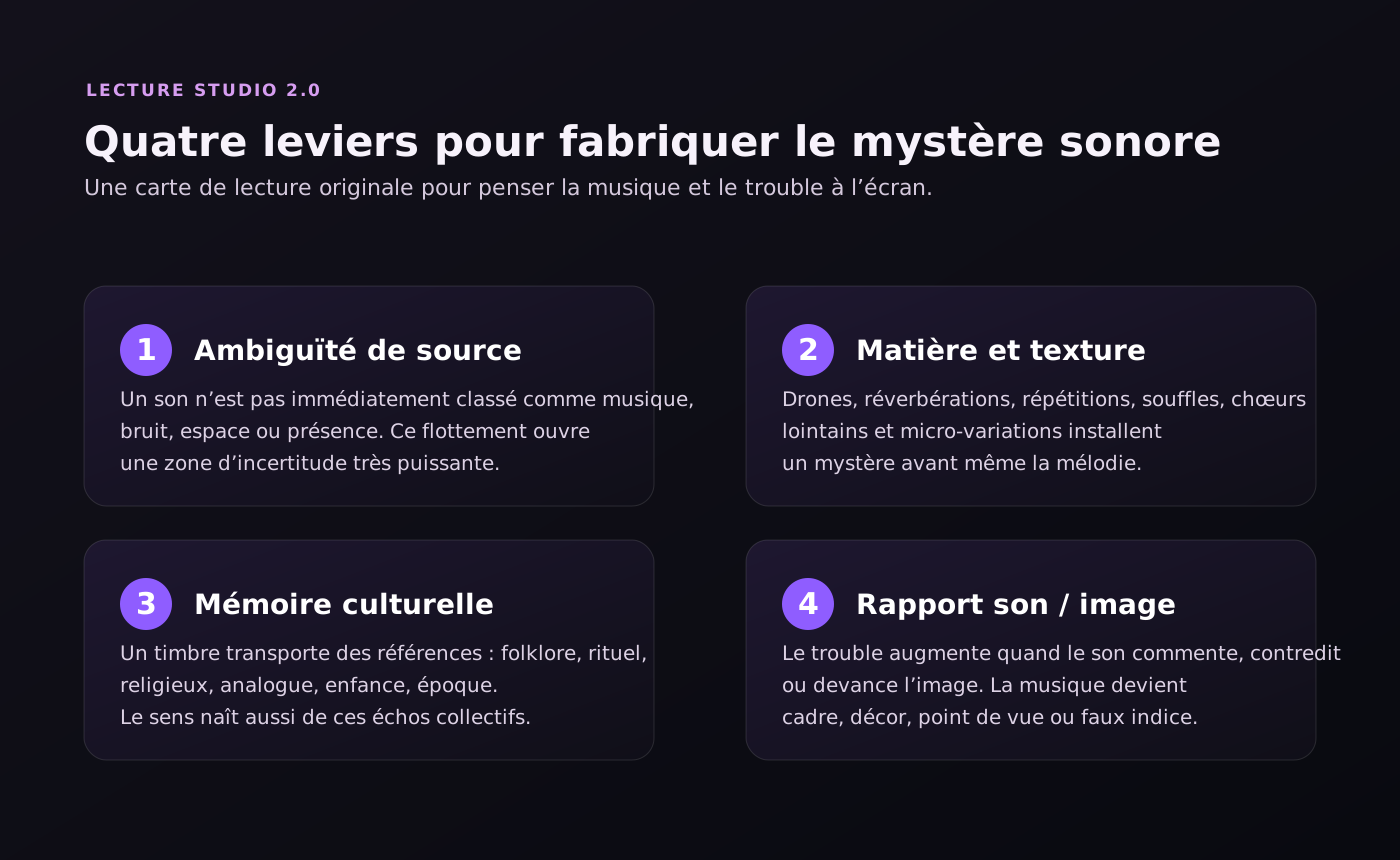
3. Textures often create the deepest unease
Slowly changing noise, rough harmonic clusters and fragile instrumental gestures can suggest movement without revealing a source. Their power comes from evolution, contrast and restraint. A texture may be more haunting when its development is barely perceptible than when every change calls attention to itself.
In scoring, such textures establish the climate long before the action accelerates. They can avoid the predictable stinger or oversized rise. A mysterious scene often benefits from restraint: one persistent sonic detail may be more convincing than an overly explicit effect.
The technique can be simple: a slowly modulated synthesiser, processed breath, natural guitar harmonics, a stretched object recording or a carefully treated voice or flute. What matters is not processing complexity but the evocative quality of the result.
4. Timbres carry cultural memory
A music box, distant radio or old recording can suggest childhood, memory or a presence from another time. Such associations are never universal, but they give the composer a rich dramatic vocabulary. The key is to understand the story and avoid using a familiar effect merely because it has worked in another film.
That is one reason symbolic or dreamlike films make powerful use of existing musical materials, songs, analogue timbres and so-called archaic colours. Meaning emerges in the meeting between a scene and the sound's cultural associations. One timbre can make an image feel older, sacred, fragile or unstable.
That calls for care from a sound creator. Ritual, religious or culturally specific sounds should be approached with awareness rather than used as easy exotic decoration. Mystery becomes stronger when the source is heard sensitively and in context.
5. Listening objects tell stories too
Speakers, telephones, radios and other devices filter the sound we associate with a character or place. The acoustic signature of those sources can become part of the narrative. A narrow-band recording or an unstable transmission may reveal more about a fictional world than an additional line of dialogue.
In memorable scenes, the playback medium can almost become a character, connecting the present to an unseen elsewhere. A vinyl record creates a different dramatic meaning from spotless digital playback: hiss, rotation, handling and fragility are already part of the story.
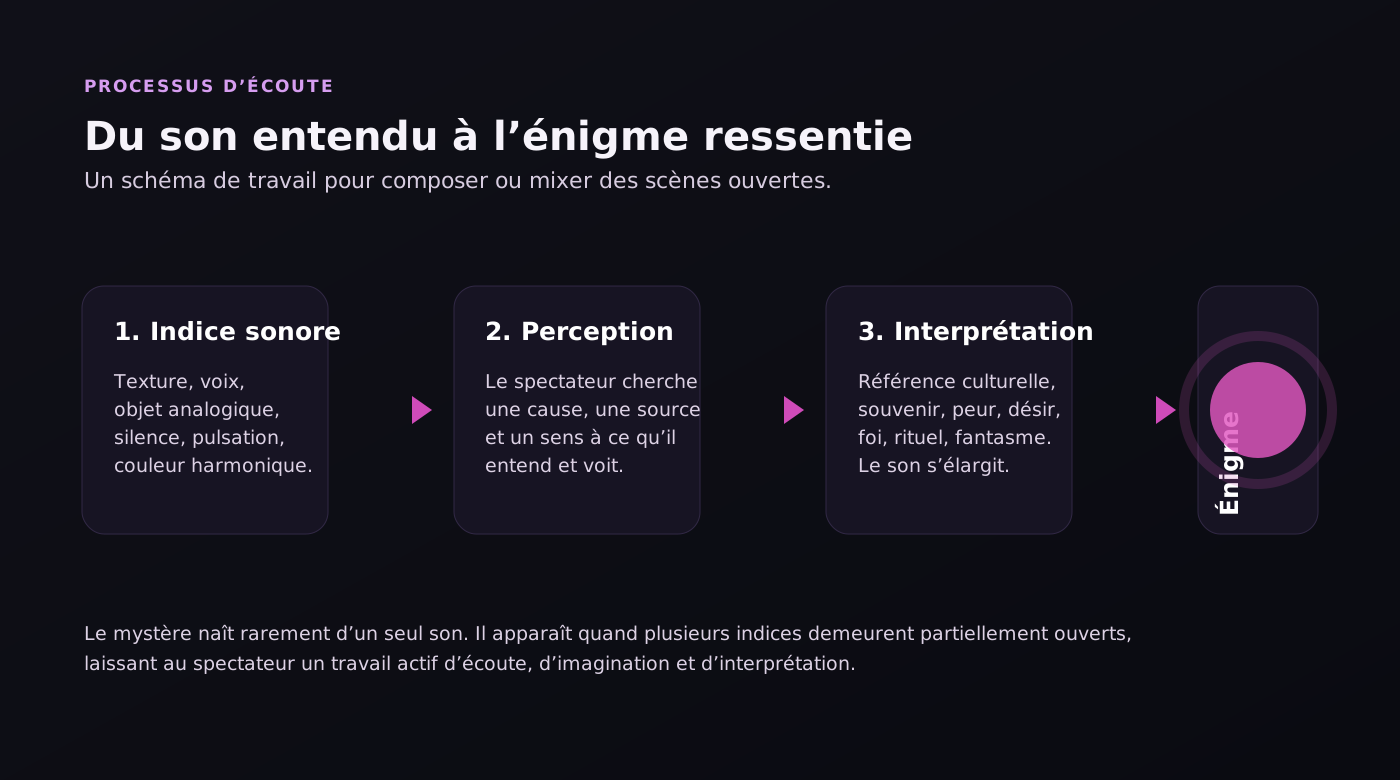
6. Image and sound interact in the viewer's mind
The same image can feel reassuring, threatening or mysterious depending on what accompanies it. Sound may confirm the apparent action or quietly contradict it. This relationship requires collaboration between composer, sound designer, picture editor and re-recording mixer, because the emotional result depends on the complete soundtrack.
Timing also matters in the edit. Music that anticipates an event has a different effect from music that accompanies or contradicts it. Sometimes a small discrepancy is most powerful: the picture seems calm while the sound hints that something is already moving beneath it.
The film offers clues and the audience assembles them into meaning. When that process remains incomplete, the enigma survives. The score need not be complicated; it must leave just enough space.
7. Five practical ways to compose or mix mystery
1. Start with a texture alone, without an explicit beat. 2. Introduce a tonal reference but delay its resolution. 3. Add a slightly processed real-world element, such as a voice, breath or object. 4. Create depth with distant sonic planes. 5. Leave some silence to keep the listener attentive.
Work with silence, delay the expected resolution, experiment with unstable pitch, blur the line between instrument and ambience, and control the apparent distance of sounds. Test each device against the scene rather than stacking them automatically. Precise restraint is often more effective than filling every moment with effects.
Arrangement matters as much as sound design. An overly explicit theme can lock the image into a single interpretation; more open-ended writing allows viewers to participate. That does not mean every cue should be abstract — only that some things deserve to remain unresolved.
8. What to avoid if you want depth
Constant drones, predictable stingers and indiscriminate distortion can quickly make suspense feel generic. A strong mystery needs dynamic contrast, perspective and a reason for each sonic event. The best soundtrack leaves space for the audience to imagine what cannot yet be seen.
A subtler mistake is believing mystery must always be dark. Bright, fragile and almost innocent sounds may be equally unsettling. Classical passages, dreamy pop and very soft timbres can create a powerful contrast when reality slips imperceptibly toward the strange.
In the studio the most useful question is therefore not 'how can I scare the audience?' but 'what do I choose not to resolve?' That is often where a genuine sense of mystery begins.
For screen composers this sits at the border of several disciplines: scoring, foley, spatialisation, musical culture, editing and the psychology of listening. Used with care, those tools create scenes that resonate long after the screening precisely because they have not explained everything.
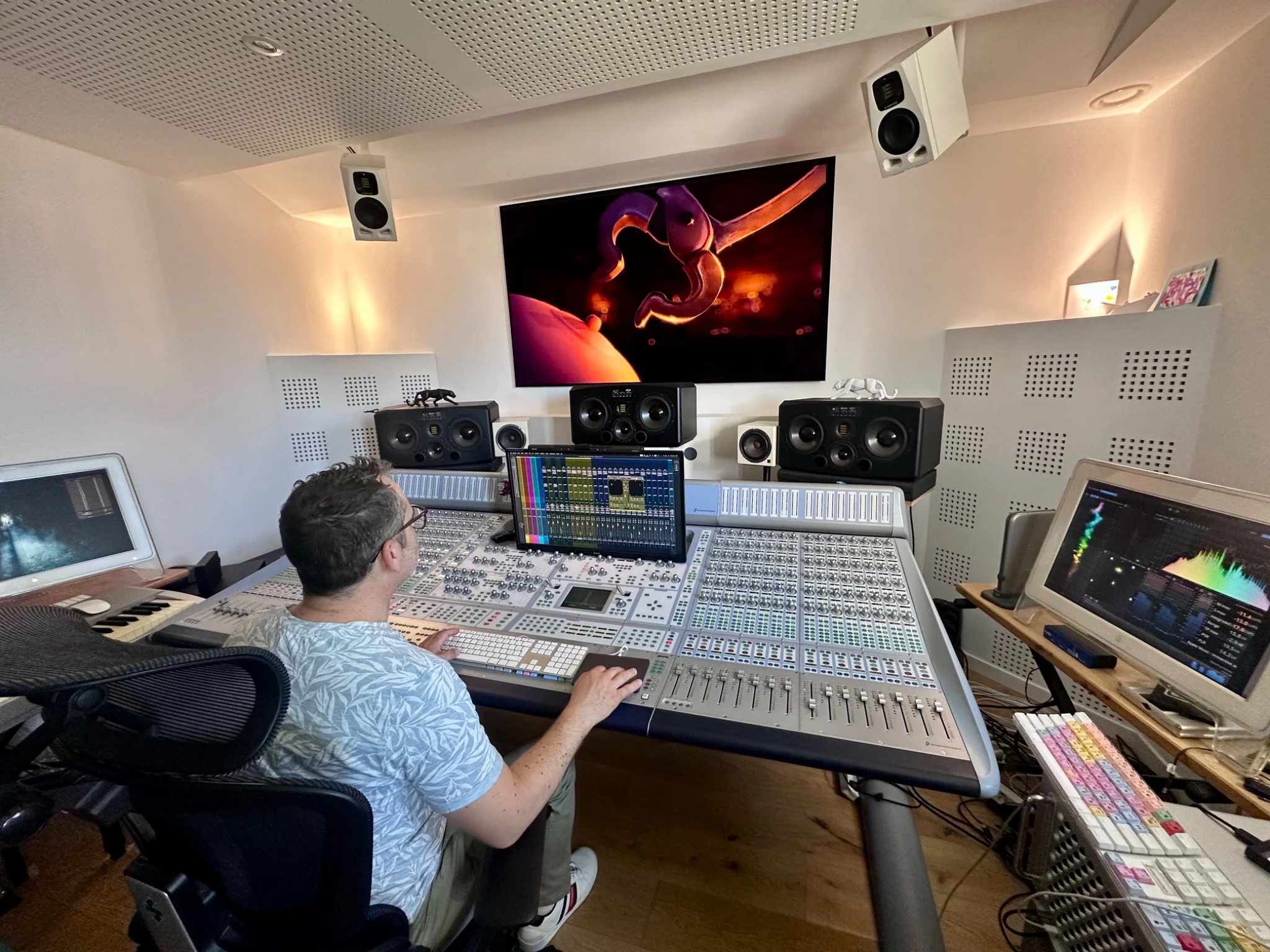 STUDIO 2.0 · ONE-TO-ONE TRAININGA different approach to composing for picture.Personalised, one-to-one training in a working studio specialising in music and sound for picture.EXPLORE THE COMPOSER TRAINING